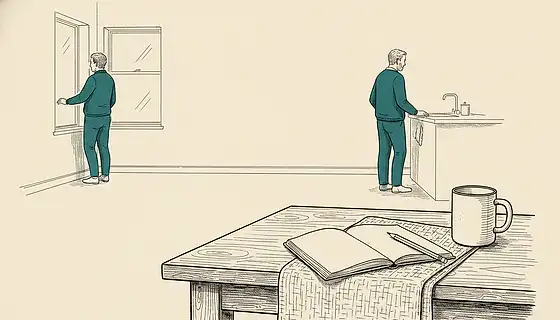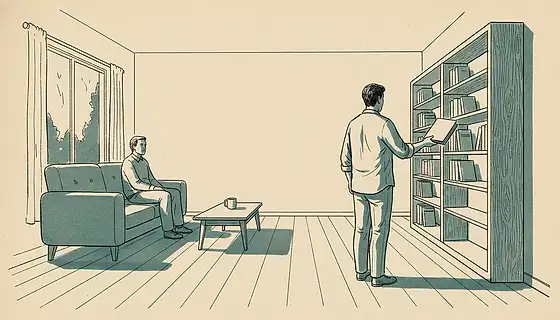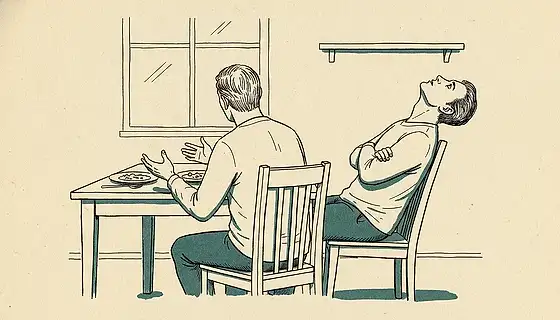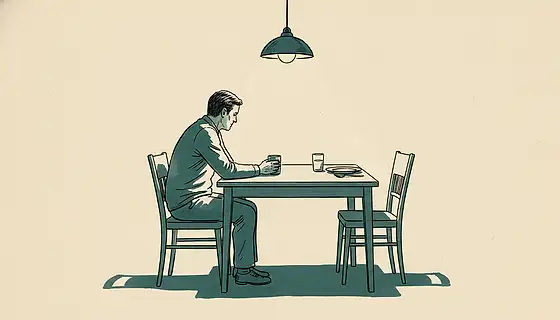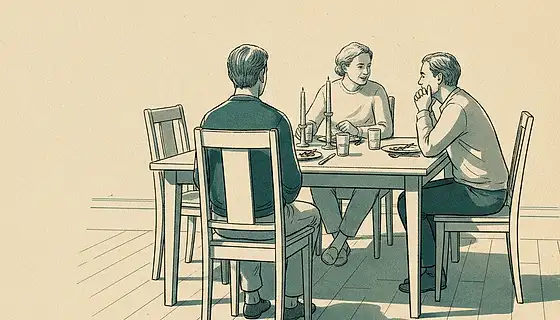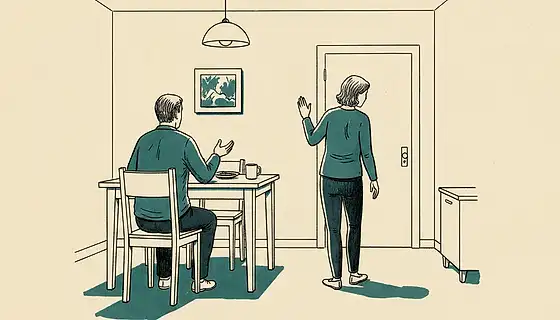
Most people meet the word after the fact. Something was said at a kitchen table, in a car, in front of friends, and it did not sound like an argument — it sounded like a verdict. Hours later the sentence is still there, and the search that follows is usually some version of what was that.
Contempt in a relationship is speaking to a partner from a position above them: the sentence is aimed at who they are rather than at what they did. That single shift is the whole subject of this site. It is what separates a hard conversation from one that leaves a mark, and it is the reason two couples can argue with the same volume and end up in completely different places.
This page is the long version: what the pattern is, what it sounds like in a normal week, where it tends to come from, what it does inside a marriage specifically, and what people who study conflict say reduces it. The three shorter routes through the site are linked as they come up — one on what the word means, one on how to hear it, one on the feelings it gets confused with.
We describe a pattern in how people talk to each other. We do not assess relationships, and there is nothing on this page that can tell you what is happening in yours.
What is contempt in a relationship?
Contempt is a claim of higher standing, delivered inside an ordinary sentence. The complaint may even be fair. What makes it contempt is the position the speaker takes while making it.
Set two sentences next to each other. You said you would call the plumber and you forgot. And: Of course you forgot. Why would I expect anything else from you. The first names a thing that happened. The second names a kind of person, and quietly puts the speaker above them.
A complaint is a statement about a specific behaviour and its cost — one event, one consequence, one request. Complaints are how two people who like each other manage a shared life; a relationship with no complaints in it is usually a relationship where someone has stopped saying things. Contempt is not a stronger complaint. It is a different move altogether, because it takes the person rather than the event as its subject, and a person cannot be fixed the way a forgotten phone call can.
There is a test that works reasonably well from either side of the conversation. Ask what the sentence would need in order to be satisfied. A complaint can be satisfied: call the plumber, come home earlier, stop reading your phone at dinner. Contempt cannot be, because the thing it objects to is the person saying it to. When a sentence has no version of the world in which it would be withdrawn, it is not asking for anything.
That is also why contempt is hard to answer. Consider what is actually available to the partner on the receiving end of why would I expect anything else from you. They can argue the facts, which misses the point. They can defend their character, which concedes that their character is what is on trial. Or they can go quiet. None of those is a conversation.
Contempt also does not need a sentence. A great deal of it is carried by a face and a posture: the eye-roll mid-explanation, the sigh timed to land on a word, the half-smile aimed at someone else in the room. What people usually mean by what does contempt look like is this wordless half of it, and it matters because it is the version that gets denied most easily — there is no transcript of a look. We keep the face and the body on their own pages rather than here, but the test is the same one: it is contempt if what is being communicated is rank rather than disagreement.

What does contempt sound like in an ordinary week?
It rarely sounds dramatic. Contempt survives in a relationship precisely because each individual line is deniable — small enough to be called a joke, a mood, or you being sensitive. Here is what it looks like as it is actually spoken, with a short naming of what each line does and the complaint that could have been made instead.
“Wow. You really thought that was going to work.” — mock admiration
The praise is the delivery vehicle. The complaint underneath might have been this plan has a problem and I am worried about it, which is arguable. Admiration that means the opposite is not.
“It is fine, I will just do it again after you.” — silent redo
Nothing here is an accusation, which is what separates it from a complaint. The work is done in front of the other person, and the message is delivered by the doing.
“Ask him. He knows what she is like.” — audience appeal
A third person is enlisted, so disagreeing now costs more than the original subject was ever worth. The line converts a private disagreement into a small public grading.
“Okay. Sure. Whatever you say.” — flat dismissal
The words agree; nothing else does. The sentence closes a conversation without ever engaging it, and leaves the other person to argue with the tone rather than the content.
“Do you hear yourself?” — sanity ranking
The question is not a question. It places the speaker in the position of the reasonable one and the partner in the position of someone who needs to be told how they sound.
Our long list, with the non-contemptuous version of each complaint written out beside it, is on examples of contempt in a relationship. The eye-roll, the sigh and the half-smile — the versions with no sentence attached — belong to contempt body language.
Where does contempt come from?
In most descriptions of the pattern, contempt arrives late. It is what a grievance turns into after it has been carried for a long time without being said in a form the other person could do anything with.
The sequence is unremarkable, which is why it is easy to miss from inside. Something bothers you. Saying it feels disproportionate — it is small, and there was a whole week to get through. So it goes unsaid, and then it happens again, and the unsaid version accumulates interest. By the time it does get spoken it is no longer you left the bin bag by the door; it is you are the kind of person who leaves things for other people. For example, six months of small unmentioned irritations do not come out as six small complaints. They come out as one sentence about character, usually at the worst available moment.
The other half of that sequence is that contempt feels, from the inside, like clarity rather than cruelty. That is the part almost nobody writes about, and it is why we gave it its own page: feelings of contempt is written for the reader who recognises the pattern in themselves rather than in a partner.
Two other routes into the same place are worth naming, because they do not look like grievance at all. One is score-keeping: a long private ledger of who did more, which converts a partner into a running total and makes every new event a data point rather than a thing that happened. The other is contempt borrowed from outside the relationship — from an exhausting job, a family that speaks this way as a matter of course, a group of friends whose humour runs on ranking people. A habit of speech picked up somewhere else does not announce itself when it arrives at home.
What all three have in common is that the person doing it is usually not trying to wound. They are trying to end an argument they have had many times already, and contempt ends arguments efficiently. It works. That is the trap: the pattern is rewarded in the short run by the silence it produces, and the cost arrives quietly, months later, in the form of a partner who no longer brings things up.
None of this is a cause in the scientific sense, and we are not claiming it as one. It is a description of a sequence people report, and it is useful mainly because it points at the moment where something else was still possible — much earlier, and much smaller, than where the argument finally happened.
What does contempt look like in a marriage?
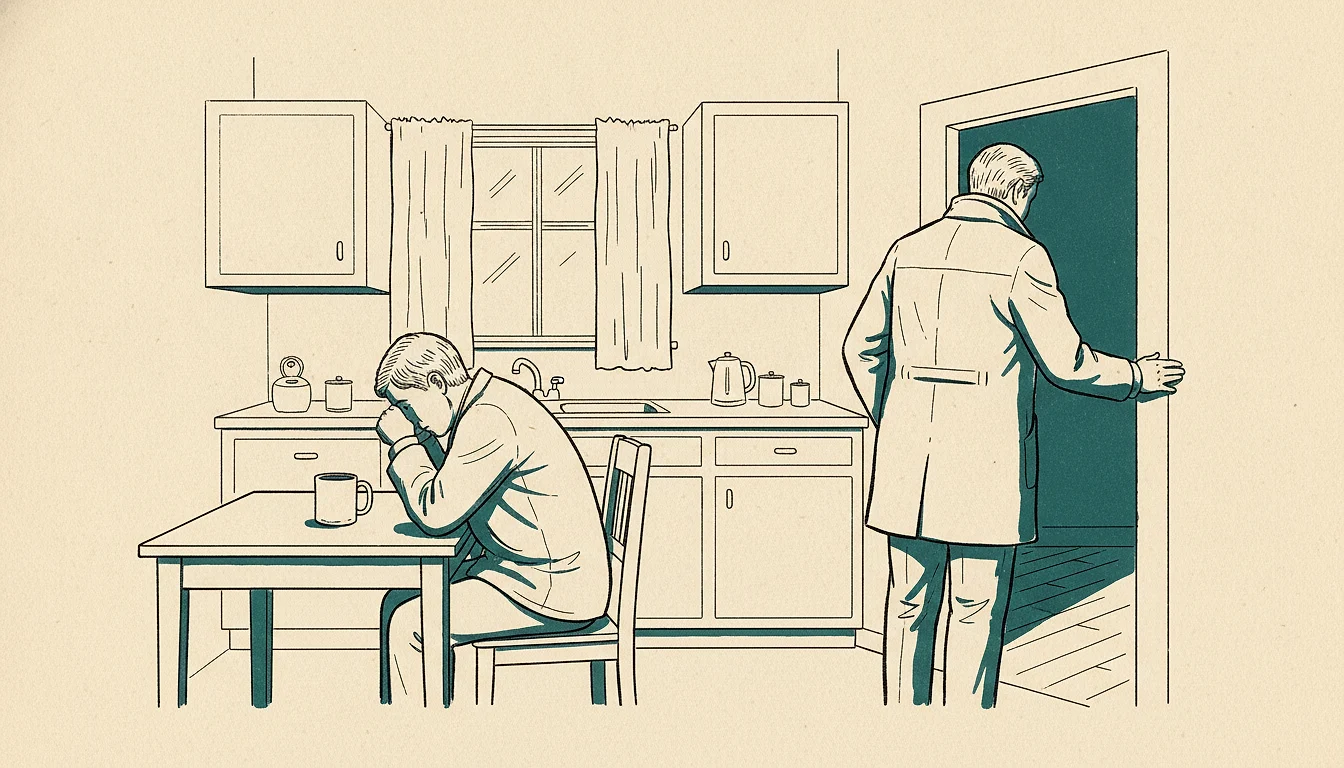
Contempt in marriage is the same pattern with the volume turned down and the timeline stretched out. Long relationships remove the need to explain, and that shortcut is exactly what contempt travels on.
Contempt in marriage is the version that has had time to become a habit — the same downward move, repeated often enough that neither person hears it as an event any more. The lines get shorter, the audience gets larger, and the pattern stops needing an argument to appear in.
Married partners share history, so a whole grievance can be delivered in three words and a look. Imagine a couple at dinner with friends: one of them starts a story, the other says this is the one where he is the hero, everyone laughs, and the story stops. Nothing quotable happened. If you asked the next morning, both would probably describe the evening as fine.
The second difference is that a marriage supplies an audience and a set of standing roles — the organised one, the one who is bad with money, the one who never listens. Contempt in a marriage often works by referring to a role rather than an event, which makes it almost impossible to answer: you cannot produce evidence against a character that has been established over years.
The third is duration. In a long relationship the pattern can settle into the furniture. Couples describe it as the point where they stopped bothering — where a partner’s answer became something to get through rather than something to hear. That state is quieter than an argument and much harder to notice, because from the inside it is indistinguishable from having grown apart.
Where does the term come from?
The relationship sense of the word comes largely from the Gottman Institute, whose description of the four horsemen names contempt as one of four conflict patterns and treats it as the most corrosive of them. That page is the canonical statement of the framing, and it is the reason people arriving here already have the word in hand.
What that framing added, and the reason the word stuck, is the observation that contempt behaves differently from the other patterns it sits beside. Criticism, defensiveness and shutting down all damage a conversation. Contempt is described as damaging the relationship’s basic premise — that the two people are equals — which is why it is treated separately rather than as an intense form of criticism.
We do not summarise the wider framework. This site is the deep page on one of those patterns — what contempt sounds like, how it differs from anger and resentment, what people report feeling while they are doing it. Everything we cite is listed on sources.
What reduces contempt?
The move that gets taught, everywhere the pattern is taken seriously, is to say the complaint underneath — while it is still small enough to be a complaint.
That means describing the behaviour and the cost, in one sentence, without the ranking. When the plumber does not get called I end up doing it in my lunch break and I am tired of it is a sentence with a request in it. Of course you forgot is a sentence with a verdict in it. The first invites an answer. The second forecloses one. The skill is unglamorous and mostly consists of saying things earlier than feels necessary.
Three things make it more likely to hold:
- Name the grievance while it is still specific. A complaint about one event is answerable. A complaint about a person is not. Most of the difficulty in this pattern is a timing problem wearing a character costume.
- Say what you notice that is good, out loud, when nothing is at stake. This sounds like greeting-card advice and it is not: the counter-move described alongside contempt is a standing habit of appreciation, built on ordinary days, not a technique deployed mid-argument.
- Let repair land when it is offered. Repair refers to any attempt — a joke, a touch, an apology, a change of subject — to stop an argument from getting worse. Contempt is particularly destructive here because it makes repair attempts look ridiculous, and a couple who cannot repair have to win every argument outright.
Sue Johnson’s Hold Me Tight (publisher page) is the book most often handed to couples for the de-escalation half of this, and it is written for two people to read together. We have no outcome to promise you from it. Books and pages are not the thing that changes a relationship; they are, at best, a way to get a name for what is happening.
How do you respond when it comes at you?
Answer the complaint, not the ranking — and only if there is a complaint in there worth answering. A sentence like of course you forgot has two parts: an event, and a verdict about you. Responding to the event keeps a conversation possible. Responding to the verdict starts a second argument about your character, which is the one nobody wins.
In practical terms that looks like saying the plain thing: I did forget, and I will call them tomorrow. I do not want to be spoken to like that, though. One sentence for the fact, one for the line. It is not a technique for winning, and it will not work reliably; what it does is keep you out of the trial. It also puts the choice back where it belongs, with the person who set the terms.
Two things not to do, both of which feel natural. Do not answer contempt with contempt: matched ranking is the fastest way to make an evening unrecoverable, and it costs you the ability to name the pattern later. And do not litigate the tone in the moment — arguing about whether a sigh was a sigh is unwinnable, and it moves the subject from what was said to whether you are being sensitive.
Be honest about the size of what any of this can do. A pattern that took years to settle in does not come apart because one person read a page and said a better sentence on a Tuesday. What the counter-moves buy is a slightly different conversation, more often, until the grievances stop arriving pre-hardened. Couples who describe coming out of this describe it as slow and unremarkable, and usually as something both people worked at rather than one.
If contempt in your relationship is coming from you, the specific version of this is on feelings of contempt. If it is coming at you, start with contempt vs anger, because the distinction between the two changes what is worth answering.
Where this page stops
Where this page stops. This page describes a pattern in how people talk to each other. It cannot tell you what is happening in your relationship, whether it is safe, or what you should do. It is not therapy and not a substitute for it. If you are frightened of your partner, a page is the wrong tool — talk to someone who can hear the specifics.